New Jersey Diminished Value Claims
You walked away from the accident. Your car went through repairs. It looks flawless. You assume you’re made whole.
You’re probably not — and here at Nigro’s Autobody, we see this every week.
After more than 30 years serving drivers across Philadelphia, South Jersey, and the surrounding region, one of the most consistent things we hear from clients is some version of: “I had no idea my car was worth less after the accident — even after perfect repairs.” That invisible financial loss has a name: diminished value. And in New Jersey, you have a legal right to recover it.
This guide explains exactly what diminished value is, what New Jersey law says about it, and how Nigro’s Autobody guides clients through the claim process — from first call to final settlement.
New Jersey Diminished Value: The Key Numbers
Key Factor | New Jersey Rule |
Statute of Limitations | 6 years from the accident date |
Third-Party Claim Permitted? | Yes — against the at-fault driver’s insurer |
First-Party Claim Permitted? | No — most NJ policies exclude DV coverage |
Property Damage Minimum | $5,000 in coverage |
UM/UIM Coverage for DV | Optional; min. $5,000; excludes hit-and-run |
Small Claims Court Limit | $5,000 (attorney representation permitted) |
Key NJ Legal Precedent | Jones v. Lahn (1949); Premier XXI v. Rigstad (2005); Financial Services Vehicle Trust v. Panter (2019) |
What Is Diminished Value?
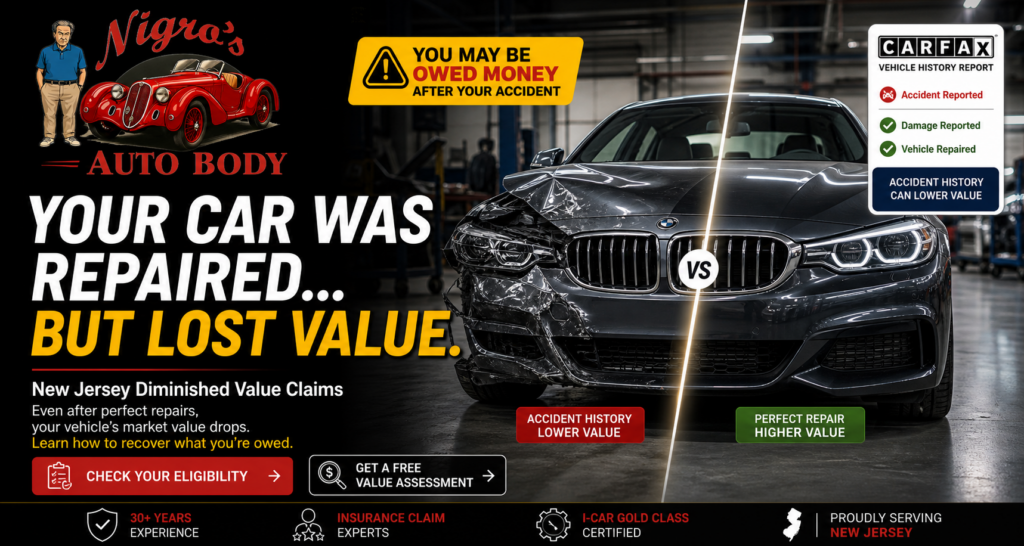
Diminished value is the reduction in your vehicle’s fair market resale value caused by its accident history — even after professional repairs have been completed.
Here’s the clearest way to think about it. If two identical 2022 vehicles are for sale — one with a clean history and one with a repaired collision on its CARFAX record — buyers will choose the clean one, or demand a steep discount on the other. That discount is diminished value, and it comes straight out of your pocket at resale time.
There are three types, but one matters most for most NJ drivers:
Inherent Diminished Value — The loss in resale value that persists because an accident appears on your vehicle’s history report. Even flawless repairs can’t erase a CARFAX entry. This is the most significant and most commonly recovered form.
Repair-Related Diminished Value — When the repairs themselves were substandard: paint mismatch, aftermarket parts, frame imperfections. The vehicle is worth less because it was never fully restored to pre-loss condition.
Immediate Diminished Value — The difference in value immediately before and after the accident, prior to any repairs. Rarely claimed in isolation.
What New Jersey Law Actually Says About Diminished Value
New Jersey has one of the clearest bodies of case law supporting diminished value recovery in the region. This isn’t a legal gray area — the courts have repeatedly affirmed the right.
Jones v. Lahn (1949)
The foundational New Jersey rule: in the absence of total vehicle destruction, damages are measured as the difference in value immediately before and after the injury. This established that repair costs alone do not make a vehicle owner whole.
Fanfarillo v. Eastend Motor Company
Courts clarified that if a vehicle was worth more before the damage than after repair, the owner is entitled to recover the depreciated value in addition to the cost of repairs.
Premier XXI Claims Mgmt v. Rigstad (2005)
When repairs still leave a vehicle in a less valuable condition than before the accident, a plaintiff may prove full damages by showing either (a) repair cost plus post-repair depreciation, or (b) the before-and-after accident value gap.
Financial Services Vehicle Trust v. Panter (2019)
The most recent Appellate Division decision confirms that motor vehicle owners may recover for diminution of value — as long as the proper proofs are presented.
Third-Party vs. First-Party Claims: What NJ Drivers Can Actually Pursue
Third-Party Claims (The Standard Path)
If another driver caused your accident, you file a diminished value claim against their liability insurance — not your own. This is fully permitted under New Jersey law and is the primary route for most NJ drivers.
The at-fault driver’s insurer is responsible for your vehicle’s lost market value on top of repair costs. You are not limited to just getting your car fixed.
First-Party Claims (Generally Blocked in NJ)
Most standard New Jersey auto insurance policies explicitly exclude diminished value coverage. Filing against your own insurer for DV is typically not an option unless you have specific optional endorsements.
Uninsured/Underinsured Motorist (UM/UIM) Coverage
If the at-fault driver was uninsured or underinsured, you may file a diminished value claim through your own UM/UIM coverage — but only if you opted into this coverage. Note: NJ UM/UIM does not cover hit-and-run accidents.
The NJ Diminished Value Statute of Limitations: 6 Years, But Don't Wait
New Jersey gives you 6 years from the date of your accident to file a property damage claim. That sounds like plenty of time — but waiting is one of the most common and costly mistakes NJ drivers make.
Here’s why earlier is always better:
- Evidence degrades fast. Repair invoices get misplaced. Damage photos disappear. The vehicle changes condition, making it harder to attribute any loss specifically to this accident.
- Natural depreciation muddies the water. The longer you wait, the harder it becomes to isolate the accident-related diminishment from ordinary market depreciation.
- Insurance companies exploit delay. Adjusters know that stale claims are harder to substantiate. They will use the passage of time against you in every negotiation.
How Much Is a New Jersey Diminished Value Claim Worth?
New Jersey does not mandate a specific calculation formula for diminished value — unlike some states. This flexibility is exactly what insurance companies exploit to issue lowball settlements, and why professional appraisal matters so much.
The factors that determine your claim’s value:
- Pre-accident market value: Higher-value vehicles suffer greater absolute diminishment. A $65,000 luxury SUV will lose more in dollar terms than a $12,000 economy car.
- Severity of structural damage: Frame damage, airbag deployment, and structural repairs create the largest stigma discounts in the market.
- Vehicle age and mileage: Newer, lower-mileage vehicles experience higher diminished value because buyers have higher condition expectations.
- Market demand: High-demand makes and models may lose more proportionally because buyers have more alternatives.
Industry data consistently shows that accident-history vehicles sell for 10–25% below comparable clean-title vehicles. On a $40,000 vehicle, that’s $4,000 to $10,000. At Nigro’s, our average client recovery across PA and NJ is $4,750 — money that belongs to you, not the insurance company.
How Nigro's Autobody Handles Your NJ Diminished Value Claim
Step 1: Free Case Review
Call us at (215) 925-4520 or submit your details at nigrosautobody.com/diminished-value-claims-philadelphia. We review your situation — vehicle, accident details, repair scope — and give you an honest initial assessment of whether you have a viable claim and approximately what it may be worth.
Step 2: Professional Diminished Value Appraisal
This is the foundation of your entire claim. New Jersey courts require “proper proofs” — and that means a credentialed, independent appraisal, not an insurer’s internal estimate or your own calculation.
Our appraisal documentation includes:
- VIN-verified vehicle profile and pre-accident market value
- Documented damage and repair scope
- Market-based comparable sales analysis (clean-title vs. accident-history vehicles)
- A specific, defensible dollar figure for the inherent diminished value
- Signed certification suitable for insurer submission and court use
Step 3: Demand Letter Submission
Armed with your appraisal, we help prepare a formal demand letter to the at-fault driver’s insurance company — citing applicable NJ case law (Jones v. Lahn, Premier XXI v. Rigstad, Financial Services v. Panter) and specifying the exact recovery amount.
Step 4: Negotiation
Insurers will counter-offer below your demand. That’s standard. With professional documentation and our 30+ years of experience dealing with insurance adjusters in NJ and PA, we help clients push back with evidence — not just frustration. Most claims settle at this stage.
Step 5: Escalation if Needed
If an insurer refuses to negotiate in good faith, NJ Small Claims Court (up to $5,000) is an option for lower-value claims. For higher-value cases, we connect clients with experienced property damage attorneys who understand diminished value litigation in New Jersey.
What Insurance Companies Don't Want You to Know
After three decades of working with NJ and PA insurance adjusters, we’ve seen every tactic in the playbook. Here are the most common ones used against diminished value claimants:
- Silence: Insurers are not legally required to inform you of your right to file a diminished value claim. Most won’t bring it up.
- “We don’t pay diminished value”: This is false for third-party claims under New Jersey law. It’s a bluff — and it works on drivers who don’t know better.
- Proprietary lowball formulas: Some insurers use internal calculators designed to suppress DV values. These are not legally binding in NJ.
- General release traps: If you sign a full and final release without reserving your diminished value rights, you may forfeit your entire claim. Read every document before signing.
- Delay tactics: The longer a claim drags on without documentation, the harder it becomes to pursue. This is intentional.
Does Your Vehicle Qualify for a Diminished Value Claim in NJ?
Not every accident generates a meaningful diminished value claim. Here are the strongest qualifying indicators:
- Vehicle is 7 years old or newer
- Pre-accident market value of at least $10,000
- Accident involved structural damage, frame work, or airbag deployment
- Another driver was clearly at fault
- Repairs were completed by a qualified shop with documented invoices
- The accident appears on CARFAX or AutoCheck
Don’t assume a minor-looking accident doesn’t qualify. We’ve seen significant inherent diminished value on relatively light repairs, simply because the CARFAX entry exists. The only way to know for certain is a professional assessment — which Nigro’s provides free of charge as your starting point.
Why New Jersey Drivers Choose Nigro's Autobody for Diminished Value
30+ Years Serving PA & NJ | 850+ Claims Processed | $2.4M+ Total Recovered | AAA Certified I-CAR Gold Class |
Nigro’s Autobody has served the Philadelphia and South Jersey region for over 30 years. We’re not just a repair shop — we’re your advocate through the entire post-accident process.
What makes us different on diminished value claims:
We know both sides of the transaction. As an AAA-certified, I-CAR Gold Class collision repair facility, we understand exactly what insurers look for — and what they try to avoid paying.
We’re local. We serve PA and NJ drivers. We know the regional market comparables, the local adjusters, and the NJ case law that supports your claim.
No upfront fees. We only get paid if you recover. There’s no financial risk to starting a case review with us.
We handle it for you. From appraisal to demand letter to negotiation, we manage the process so you don’t have to argue with adjusters yourself.
As our CEO Domenic Nigro puts it: “We treat every car as if it were our own and every customer like a neighbor.” That extends beyond the repair bay — it means making sure you walk away with every dollar you’re entitled to, not just a car that looks good.
Common Mistakes NJ Drivers Make with Diminished Value Claims
- Accepting the first settlement offer without asking whether DV was included
- Signing a full release without reserving their right to pursue diminished value separately
- Waiting months before acting, then finding documentation is harder to assemble
- Relying on the insurer’s internal DV valuation rather than an independent appraisal
- Assuming their own insurance covers diminished value under a standard NJ policy (it almost certainly doesn’t)
- Thinking the accident “wasn’t serious enough” to warrant a DV claim — without getting a professional assessment first
Ready to Find Out What You're Owed?
Most New Jersey drivers leave thousands of dollars on the table after an accident — not because the law isn’t on their side, but because they don’t know what they’re entitled to, or they try to fight the insurer alone without the right documentation.
Nigro’s Autobody has recovered over $2.4 million for clients in PA and NJ. Our free case review takes minutes, and it costs you nothing to find out what your claim may be worth.